4
Only briefly is it noted in official records that Emily Ensminger wove rugs during her first month at Elsewhere in the Spring of 2012. The “museum” contained, among its plethora of twentieth century detritus, a sizable collection of fabric, residual from the heyday of Greensboro’s once booming textile industry.10 Back then, Elsewhere’s leadership was more eager to carve out new spaces in the building than utilize the least-used materials in the collection. Elsewhere was discussed as a self-maintaining, self-reproducing system that could generate endlessly from the materials it had, but this autopoietic value was contradicted by utilitarian processes that harnessed only what was “useful” and cast aside the remainder as waste. Despite the idea of resourcefulness being present in the organization’s language, putting it into practice was something of a foreign concept. In stark contrast, it was with the smallest scraps that Ensminger spent evenings making her rugs (Fig. 9).
The motivation was simple: the rugs were to be placed at bedside, providing a soft mat for residents’ feet as they stepped out of bed in the morning, covering the cold, splinter-ridden floorboards. Too taxing a task for Ensminger to accomplish on her own, she enlisted the assistance of fellow residents at Elsewhere and others from the wider community. In teaching others the technique, she not only transformed the solo effort into a collaborative one but into a joyful and conversational project. As each rug was crafted, so too were social bonds crafted, the very basis of society.
The motivation was simple: the rugs were to be placed at bedside, providing a soft mat for residents’ feet as they stepped out of bed in the morning, covering the cold, splinter-ridden floorboards. Too taxing a task for Ensminger to accomplish on her own, she enlisted the assistance of fellow residents at Elsewhere and others from the wider community. In teaching others the technique, she not only transformed the solo effort into a collaborative one but into a joyful and conversational project. As each rug was crafted, so too were social bonds crafted, the very basis of society.
[10] The “heyday” of course is inseparable from the South's difficult history of textile labor. It was a product of plantation slavery for a long time, and industrial textile manufacturing after the late nineteenth century was not much better. The evils of the former should be obvious, and the latter was marred by rough working conditions, struggles with unionizing, and wage-slavery. Industrial textile production today is still in large part a sweatshop business that can fall into either of those scenarios. Though Greensboro was once home to the Cone Mills Corporation—formerly the largest producer of denim in the country—that industry has since waned in the area.
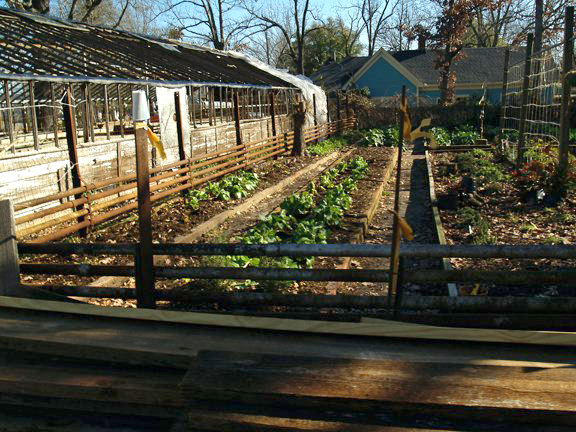
Fig. 10: Roll’s Florist Farm, 2009
Reimagining society through local action in scrappy places was nothing new for Ensminger. Since 2009, amidst the storm of the Great Recession, she had operated the Roll’s Florist Farm, a community-supported agricultural endeavor of her own creation in her hometown of Durham (Fig. 10). The site of a former flower shop and greenhouse was reconfigured as a garden for cultivating fresh produce. It was one of a few inner-city farms she and her father developed together, with the repurposing of spaces being their standard strategy. Ensminger had been trained in the visual arts, but “art” was never the point of her urban farming. Rather, art was a way of thinking through the process, or, a spirit of intention. Her goal was social sustenance, concretized in the reproduction of food.
Ensminger’s general method stems more from agriculture and food service than the arts. Her approach to art is as a structure for otherwise non-art efforts—art is the frame rather than the image.11 She refers to this as her “systems thinking,” a mode of identifying needs and organizing accordingly.12 This is not an analytical practice in the economic or technocratic sense—it is conceived in a fundamentally ecological understanding. While economy deals in laws and conditioned behavior, ecology emphasizes interconnectedness, relations, communication, and codependence. “Eco-art” is not necessarily social—in fact, much of it is quite anti-social—yet Ensminger’s studies of organic systems led her in a strictly social direction.13
Ensminger’s general method stems more from agriculture and food service than the arts. Her approach to art is as a structure for otherwise non-art efforts—art is the frame rather than the image.11 She refers to this as her “systems thinking,” a mode of identifying needs and organizing accordingly.12 This is not an analytical practice in the economic or technocratic sense—it is conceived in a fundamentally ecological understanding. While economy deals in laws and conditioned behavior, ecology emphasizes interconnectedness, relations, communication, and codependence. “Eco-art” is not necessarily social—in fact, much of it is quite anti-social—yet Ensminger’s studies of organic systems led her in a strictly social direction.13
[11] It is difficult to classify Ensminger as an artist. While at times she could be considered a conceptual artist, this is complicated by the materiality of her work. We might identify her as a textile artist, but only in the broadest terms, at which point textile becomes too limiting a descriptor. It is feasible to lump Ensminger into the category of social practice, but the formalities of the genre are largely absent from her thought. None of these definitions are entirely accurate, nor are they dismissible, and it is in this artistic ambiguity that Ensminger has stitched herself.
[12] Interview with Emily Ensminger, May 19, 2020.
[13] To the extent that Ensminger is an artist, her social and ecological focus places her projects within the genealogy of Agnes Denes’s Wheatfield—A Confrontation (1982) and Haha’s Flood: A Volunteer Network for Active Participation in Healthcare (1992–1995), though these examples were far more visible.
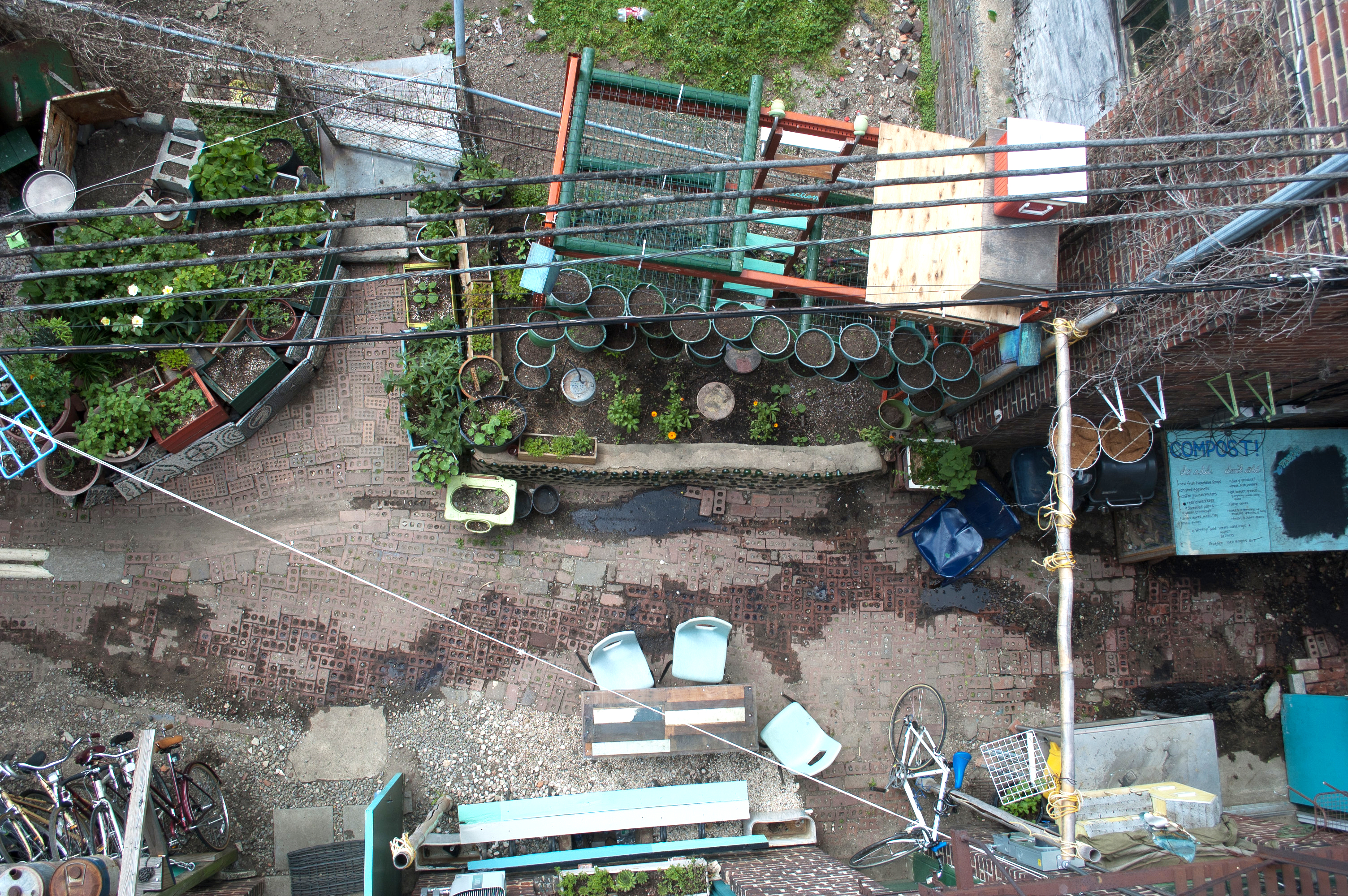
Fig. 11: Emily Ensminger, The Ground Up, 2012
At Elsewhere, her ecological mindset persisted. When she wasn’t making rugs, she was devising another urban garden, The Ground Up (Fig. 11). Ensminger configured Elsewhere’s back alley as a space for both socializing and sowing seeds, dramatically increasing its capacity for planting. “Working the land” in a cramped downtown alleyway took shape in tiered beds and pots stacked vertically on scaffolding. Everything was deconstructed several years later, and the garden expanded into a bigger yard behind the alley, but the spirit of artful labor introduced by The Ground Up persisted in other areas.
Housepitality grew out of Ensminger’s residency, as if it had sprouted directly from the soil tilled in Elsewhere’s alley. As with The Ground Up, it began with questions of needs and sustainability, but like Ensminger’s prior practice in urban farming, it was inseparable from the precarious economic conditions of the time. Ensminger proposed the Housepitality department and its Curator position according to both what she saw as Elsewhere’s needs and what her own needs were, having struggled to find jobs beyond waiting tables. But this presented a tactical opportunity—Housepitality could be, in all meanings, an occupation.
At Elsewhere, her ecological mindset persisted. When she wasn’t making rugs, she was devising another urban garden, The Ground Up (Fig. 11). Ensminger configured Elsewhere’s back alley as a space for both socializing and sowing seeds, dramatically increasing its capacity for planting. “Working the land” in a cramped downtown alleyway took shape in tiered beds and pots stacked vertically on scaffolding. Everything was deconstructed several years later, and the garden expanded into a bigger yard behind the alley, but the spirit of artful labor introduced by The Ground Up persisted in other areas.
Housepitality grew out of Ensminger’s residency, as if it had sprouted directly from the soil tilled in Elsewhere’s alley. As with The Ground Up, it began with questions of needs and sustainability, but like Ensminger’s prior practice in urban farming, it was inseparable from the precarious economic conditions of the time. Ensminger proposed the Housepitality department and its Curator position according to both what she saw as Elsewhere’s needs and what her own needs were, having struggled to find jobs beyond waiting tables. But this presented a tactical opportunity—Housepitality could be, in all meanings, an occupation.
 Fig. 12: Emily Ensminger working in Elsewhere’s kitchen, 2012 (still from “Wild Game Dinner”)